

Non-traditional Models
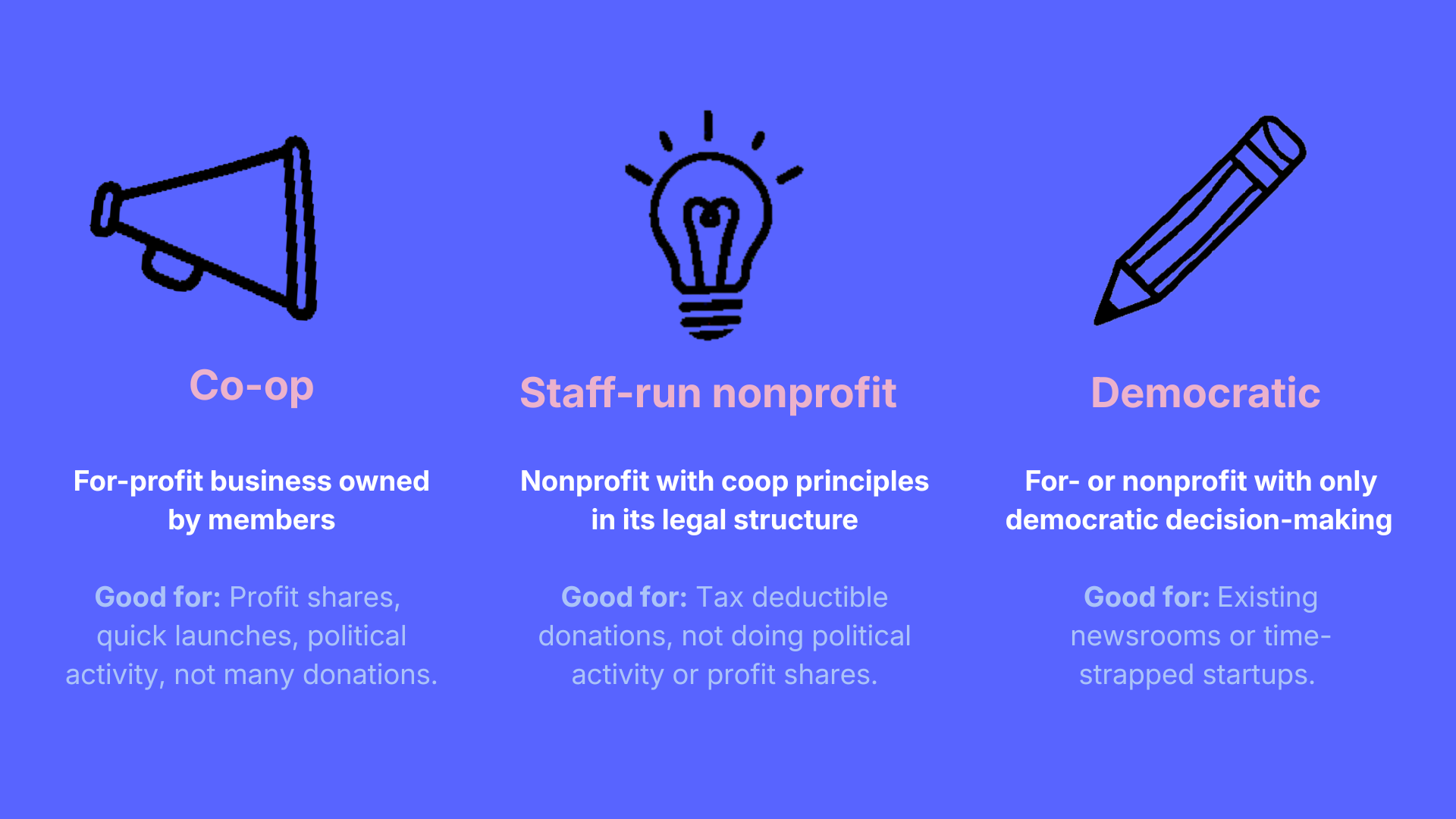
Non-traditional, worker-friendly (often called worker-led or worker-run) newsrooms empower journalists to make critical business decisions. They give journalists a voice and a choice over their work and long-term future. Through collaboration and consensus, journalists are empowered to make organizational decisions. There are 3 types: co-op, staff-run nonprofit, and democratic newsrooms:
While there’s no utopian workplace, these journalists are building stronger newsrooms. Broadly, coop and democratic workplaces are more productive, offer higher wages and economic stability, address inequality, and build community wealth. Journalists say they are more motivated, less burnt out, and have greater job security.
These newsroom models are not only viable and sustainable, but can reach significant audiences, meet demand for independence, repair trust, and serve communities better. They are equipped to meet this moment and may even “drive journalism’s wider rehabilitation.” They’re good for journalists and journalism.
Learn more about each of the 3 models below (note: this is just a guide and is not intended to be a substitute for legal advice). If you’re not sure which model is right for you take this quiz.
Co-ops
a.k.a worker-owned
or journalist-owned
For-profit businesses owned by its members. In journalism, the most common co-op is a worker co-op, where the owners are the day-to-day workers. These owners share profits and make decisions with a “one person, one vote” principle.
-
Want to make a profit, launch quickly, won’t be receiving large amounts of donations, or want to do campaign endorsements.
-
-
Business are incorporated at the state level. The most common structure is a LLC. Other options are partnerships, corporations, or co-operative corporations.
LLCs don’t need a board, but can have one. Most corporations should have a board.
-
The most important document for an LLC is the Operating Agreement. For a corporation, its the Bylaws.
These documents should lay out, for owners and/or board members:
Membership & Equity
Who is eligible to be a member; how they’re admitted and removed; members’ rights & responsibilities; their % of ownership and what happens when they leave.
Board (if applicable)
Who is eligible; how they’re elected; directors’ rights & responsibilities
How big is the board and what meetings are required
Voting & Decision making
What are critical decisions
How are critical decisions made (who votes, and what is the approval threshold)
Finances
What contributions were initially invested and how are profits distributed
If/how sweat equity of co-founders is recognized
Dissolution
What happens if you close
To incorporate, you’ll also need an EIN, Articles or Certificate of Incorporation, and a board and officers (if applicable). Be sure to work with an accountant to also select a tax status.
-
Pros:
Quick and flexible: LLC is the easiest model to incorporate, with fewer requirements. You can also convert to a nonprofit later.
“We went this route, because it felt very difficult to figure out how to launch a nonprofit… Maybe not right now while we’re trying to figure out how to run a business.” – Em Cassel, Racket
Profit sharing: The potential to earn proceeds is important for some teams, particularly if there are early financial sacrifices. Profit sharing can also be a healthy motivator.
“Things just work better from a purely capitalistic view when people have a stake in what they’re doing. It’s not because I want to kumbaya at a campfire with my comrades. The company runs better.” – Sam Cole, 404 Media
Political activity: Able to make campaign endorsements.
Cons:
Donations: Not able to provide tax deductible donations, which makes you ineligible for many grants, particularly from foundations. A solution is working with a fiscal sponsor to accept those funds on your behalf for a small fee (Hell Gate uses IRE).
-
SPOTLIGHT: Racket
Racket is published by Goof Responsibly, LLC incorporated in Minnesota.
Equity: 4 co-owners with 25% equity.
Voting/ Decision-making: Seek consensus with “one person, one vote.”
Compensation: No salary, profits are equally shared 4 ways each month.
SPOTLIGHT: Hell Gate
Hell Gate is published by Hell Gate LLC, incorporated in New York.
Governance: Worker owner board (Monthly worker owner meeting) made up of full-time journalists on staff.
Management: Uses a collective approach where work is overseen by committees.
Voting/Decision-making: Most decisions are consensus in committees, but involve the worker owner board when it involves large expenses, hires, and changing key policies (if necessary, 75% threshold).
Compensation:
SPOTLIGHT: Defector
Defector is published by Defector Media LLC, incorporated in New York. There are two share classes.
Governance/Management: 5-person management board includes Editor-in-Chief, Vice President of Revenue & Operations, and 3 editor and writer elected representatives.
Management: Uses a collective approach where work is overseen by committees and editorial is more traditional top-down.
Equity: Original 19 co-founders have 5.26% equity. If they leave they keep equity, but lose voting rights.
Voting/ Decision-making: Significant decisions such as firing an executive sit with all staff, but most decisions are made by the board and, as much as possible, committees. Critical decisions follow “one person, one vote” of active employees and need 66% approval.
Compensation: All staff have same base salary, quarterly target payouts are based on role (writers, editors, etc.) and financial performance. Bonuses can also be paid.
SPOTLIGHT: Range
Range is published by Range Media, owned by Spokane Workers Cooperative, a limited cooperative association (a Washington State model).
Governance: SWC board has 4 members, with a supermajority of worker-owners and up to 33% investor representation.
Management/Voting: Range Media oversees its own day to day work with one person, one vote.
Compensation: Mostly salary, but 4.5x split for any profit share (4 full time staff and 1 part time).
-
U.S. Federation of Worker Co-operatives
Staff-Run Nonprofits
a.k.a worker-led or worker
self-directed nonprofit
Combines the democratic principles of co-ops with the structure and legal requirements of being a nonprofit. Staff manage the day-to-day work and completely or partially control the organization’s governance. (Note: these are not co-ops as they don’t have owners)
-
Will be raising a majority of funds from foundations or donations.
-
-
Business are incorporated at the state level. The most common structure is a corporation. After incorporation you can apply for 501c3 tax exemption status from the IRS.
Nonprofits need a board. It depends on the state of incorporation as to whether staff can serve on the board and if there are any limits.
-
The most important document for a staff-run nonprofit is Bylaws.
(To incorporate, you’ll also need an EIN, Articles or Certificate of Incorporation, a board of directors, and officers. You’ll also want to apply for 501c3 tax exemption.)
Bylaws should lay out:
Membership
Who is eligible to be a member (i.e. have voting rights); their rights & responsibilities; how members are added or removed
Board
How big is the board and what meetings are required
Is the board makeup only staff, only external, or is there a mix (e.g. a staff representative)
Who is eligible to be a director; how are they elected; directors’ rights & responsibilities
What officers are there; how are they elected; officers’ responsibilities
Voting & Decision making
What are critical decisions
How are critical decisions made (who votes, and what is the approval threshold)
Dissolution
What happens if you close
-
Pros:
Donations: Able to offer tax deductible donations, which makes you eligible for many grants, particularly from foundations.
Cons:
Complex: A staff-run nonprofit is more complex than a coop, which is more complex than a standard LLC. It takes a bit more time to set up.
No profits: Profits cannot be redistributed to staff. This can be a downside if co-founders don’t feel like their sweat equity during the start-up phase can be recognized.
Difficult board success: If you have an external or mixed board, it can be hard to get the right balance of fundraising help, governance oversight, and support for the staff-run nonprofit model.
Political activity: Not able to make campaign endorsements.
Strict: While a company can become a nonprofit, a nonprofit cannot transform back into a for-profit. If it closes, all assets must remain with a nonprofit.
-
SPOTLIGHT: The 51st
The 51st, a local D.C. news site, launched in 2024 after the shuttering of DCist. It is incorporated as a nonprofit corporation in D.C. and uses direct democracy.
Governance: The board is only comprised of staff, who are eligible once they have worked for The 51st for a certain length of time/minimum hours per week. (Meets biweekly)
Management: Uses a collective approach where work is overseen by committees.
Decision-making: Large financial decisions, hiring decisions, and changes to major policies are made by the board by consent.
SPOTLIGHT: The Appeal
The Appeal Inc., a national outlet covering the criminal justice system, incorporated in Delaware in 2021. Staff were fired from their former employer, and negotiated to transfer assets to a new nonprofit. It had two membership classes: staff and board members, and voted to dissolve in 2025.
Governance: Mixed board of directors, mostly external experts with 1 elected staff representative.
All staff can vote on staff representative. They can nominate and object to other board members, and approve changes to bylaws.
Management: Work overseen by an elected leadership team of Managing Editor and Strategy & Legal Director, and executed by committees.
Decision-making: Almost all decisions including budgets and compensation were made at the staff level. Large financial decisions, leadership changes such as compensation or firing, and operating changes were made jointly with the board (66% approval from each group).
SPOTLIGHT: The Colorado Sun
The Colorado Sun, a state-wide outlet, was initially formed as a LLC before its 10 co-founders from The Denver Post quickly converted it to a public benefit corporation in 2018. After they realized this lead to two classes of staff — shareholders and employees — they converted in 2023 to a staff-run nonprofit that uses representative democracy.
Governance: Mixed board of directors made up of 3 non-executive staff and 2 community members set organizational strategy, executive compensation, and approves the budget.
All staff who’ve been at The Colorado Sun for at least 1 year can vote on board members. They can call board meetings, change bylaws, and dismiss board members.
Management: A 4-person executive operating committee oversees day-to-day work, as well as set compensation and manage hiring and firing.
Decision-making: Rests with the executive operating committee and board.
-
Democratic Newsrooms
More traditional for-profits or nonprofits, but have internal structures, policies, or practices that support significant democratic decision-making. Approaches include consensus-based decision-making; non-hierarchical structures; and/or shared leadership.
-
Existing organizations or new startups that want more shared decision-making but don’t have the time or desire to create new structures.
-
Canopy Atlanta, Dollars & Sense, Invisible Institute, Atlanta Community Press Collective
-
A democratic newsroom is usually structured as a traditional nonprofit (though some for-profits may exist).
For nonprofits, the most common structure is a corporation. After incorporation you can apply for 501c3 tax exemption status from the IRS.
Nonprofits need a board, and democratic newsrooms usually have a completely external board with no staff representation.
-
The most important document for a democratic newsroom that is a nonprofit is Bylaws.
(To incorporate, you’ll also need an EIN, Articles or Certificate of Incorporation, a board of directors, and officers. You’ll also want to apply for 501c3 tax exemption.)
Bylaws should lay out:
Board
How big is the board and what meetings are required
Who is eligible to be a director; how are they elected; directors’ rights & responsibilities
What officers are there; how are they elected; officers’ responsibilities
Voting & Decision making
What are critical decisions
How are critical decisions made (who votes, and what is the approval threshold)
Dissolution
What happens if you close
-
Pros:
Simpler: This approach is simpler than a staff-run nonprofit, as all paperwork maintains traditional approaches.
Traditional board: This model can offer staff a voice and a vote on day-to-day decision-making, while still retaining an external board to help provide traditional accountability, oversight, and support.
Donations: If you’re a nonprofit, you’re still able to offer tax deductible donations, which makes you eligible for many grants, particularly from foundations.
Cons:
Lack complete power: Staff do not have complete authority, so can be overruled or removed by a board.
Difficult boards: It can be hard to get the right balance of fundraising help, governance oversight, and support for a democratic newsroom model.
-
SPOTLIGHT: Invisible Institute
Invisible Institute, a nonprofit journalism production company, incorporated in Illinois in 2015.
Governance: External board of directors.
Board meetings are open to staff who can ask questions and share their work.
Management: Work is overseen by a 7-person leadership team and executed by project teams.
Decision-making: Most decisions are made by consensus in project teams or occasionally as a full staff. The leadership team makes decisions on resource allocation and overall organizational direction.
-